| System Name: | Uvel |
| Star Type: | B-Type |
| Number of Planetary Bodies: | 5 |
| Natural Satellites: | 3 |
| Other Features: | Large Asteroid Belt Stelvik Station |
Uvel Star
The star in the Uvel System is a B-Type blue-white star. It’s temperatures range between 10,000 and 30,000 degrees Kelvin. Like other stars in its class, it is a very rare find and the only known B-Type in the region.
Uvel I
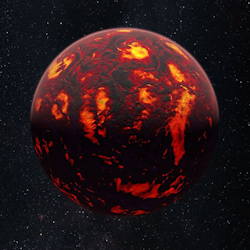
Uvel I is a Class-G planetoid in orbit of the Uvel Star. Its surface is nearly covered in volcanic activity, and it is completely uninhabitable. Daytime surface temperatures are estimated to reach over 440 degrees Celsius while nighttime surface temperatures are estimated to fall to around -200 degrees Celsius.
Surface scans indicate that there are no metallic compounds on the planetary surface due to the intense temperatures. Visual recordings indicate that the planet does not rotate on a central axis and therefore the cold side remains facing away from the star at all times. There are hundreds of active volcanic eruptions daily on the surface.
Uvel II
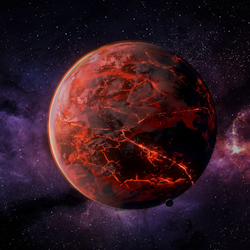
Uvel II is a Class-G planet in orbit of the Uvel Star. Its surface is covered in volcanic activity, though it’s not nearly as active as Uvel I. The surface temperatures can reach 400 degrees Celsius while at night falling to around -160 degrees Celsius.
Surface scans indicate that there are some mineral resources on the planet’s surface. However, due to the intensity of the surface temperatures it is impossible to collect them. Near the southern pole there is an active volcano that covers several hundred kilometers.
Uvel III
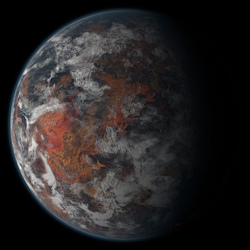
Uvel III is a Class-D planet in orbit of the Uvel Star. It is a very mineral rich planet, though it lacks any sort of atmosphere. It is unclear if the planet ever had an atmosphere as it’s just outside the habitable zone in the system. The planet has one natural satellite in a decaying orbit and it’s close enough to the asteroid field to get bombarded by meteor and asteroid showers, though these events are quite rare.
Uvel III is home to most of the surface mining operations in the Uvel System. There is a rich dilithium field on the planet along with duranium, titanium, magnesium, and other metals. Stelvik Station is in high orbit around Uvel III.
Uvel IV
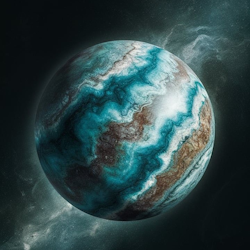
Uvel IV is a Class-J gas giant with two natural satellites in orbit of it. The planet has not been fully surveyed due to the high gravitational sheer when getting close to the planet. Long range scans of the surface indicate that it’s regularly hammered by strong geometric storms that regularly tear through it’s gaseous atmosphere.
The gravitational pull is strong enough that large asteroids from within the asteroid field are regularly pulled into it. The surface is a mass of swirling blue and light bluish colors. It is believed to contain large quantities of gaseous methane, though that remains undetermined. It is believed that there may be gaseous deuterium in orbit.
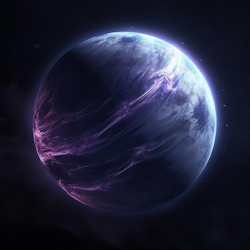
Uvel V
Uvel V is a Class-J gas giant. Due to the orientation of its orbit in the outer edge of the system, the planet spends part of its orbit as the fourth planet rather than the fifth planet. The gases in orbit around the planet are swirls of purple and light purplish in color.
There are regular electromagnetic storms on the planet. These systems have been observed to last for months and sometimes even years in its orbit. Little is known about what kinds of gases are there.
Asteroid Field
There is an asteroid field located between Uvel III and Uvel IV, that is quite massive in size. Some of the asteroids in the belt are large enough to land small runabouts on them. The asteroids are also rich in metals. There are estimated to be more metals in the asteroid field than on Uvel III. Asteroids from the belt are regularly being pulled into orbit around both Uvel III and Uvel IV before crashing into either planet.